
For fiscal year FY23, the 2022 Union Budget had targeted a capex outlay of Rs 7.5 trillion, which is 35.4 per cent higher than the FY22 Budget Estimate of Rs 5.54 trillion.

JSW Steel (3.37 per cent), Tata Steel (3.33 per cent), Maruti (3.24 per cent), Power Grid (3.07 per cent), IndusInd Bank (2.95 per cent), Bajaj Finance (2.12 per cent) and Tech Mahindra (2.22 per cent) were among major gainers. On the other hand, Ultratech Cement, Sun Pharma, Nestle and L&T were the losers.

Global trends, trading activity of foreign investors, outcome of state elections and RBI's interest rate decision are the major factors that will drive the movement in the domestic equity markets this week, analysts said. "Global markets are currently in a fabulous mood. The US 10-year bond yield and the dollar index are also cooling off, which gives strength to the market. These factors will be closely monitored, as they have the potential to influence market sentiment," said Pravesh Gour, senior technical analyst, Swastika Investmart Ltd. On the political front, the results of assembly elections in five states are eagerly anticipated, Gour said.

IMF cut its 2016 global growth forecast for the fourth time in the past year to 3.2 per cent, citing China's slowdown.

'In the next one-and-a-half, two months you'll get decent amount of opportunities in the mid-cap and small-cap sector at lower levels.'

The ministry of defence has set a goal of $26 billion, including export of $7 billion for the industry by 2025-26 through its Defence Production Policy 2018.

'There is a behavioural shift and conservativeness with companies cutting down on manpower and rationalising the number of people.'

The COVID-19 pandemic and the ensuing restrictions in mobility may result in a 75 per cent reduction in the budgetary allocation for foreign travel in FY22, a senior finance ministry official said. The government will cut "frivolous expenditure" when all the activities are going on in the virtual mode, joint secretary in the ministry of finance, Madnesh Kumar Mishra, said in an event organised by XLRI. It can be noted that the budget for the next fiscal is under preparations right now and officials are also having discussions internally and also with external stakeholders for suggestions.

It has mostly been a one-way street for smallcap stocks that have taken it on their chin thus far in February. The Nifty Smallcap 250 index has shed 3.2 per cent in the current month as compared to the 1.8 per cent decline in the Nifty Midcap 100 and the 0.5 per cent drop in the Nifty 50 index, data showed. Technically, the index has slipped below its 20-day moving average (DMA) placed at 14,800 levels on Monday, and is currently testing the 50-DMA, and is placed at 14,278 levels.

The home loan top-up, a kind of secured multipurpose personal loan, is on the regulator's radar, points out Tamal Bandyopadhyay.

Even as services helped the Indian economy clock better than expected growth in the first half, many economists say that the sector would slow down much more in the second half and restrict growth to seven per cent or less for the whole fiscal.

Omkeshwar Singh, Head, Rank MF, a mutual fund investment platform, answers your queries.

How could India@75 improve law and order, courts, social, physical and soft infrastructure, efficient cities, e-governance, ease of doing business and other essential state functions by 2022, asks Shailesh Pathak.

Among the Sensex firms, Larsen & Toubro, UltraTech Cement, JSW Steel, Titan, Bajaj Finance, Wipro, Tech Mahindra and Nestle were the major laggards. Maruti, Power Grid, Axis Bank, State Bank of India, NTPC, HDFC Bank, ITC and IndusInd Bank were the gainers.

The move by the second largest private sector lender will give better returns on fixed deposits, but will also make loans more expensive for existing customers.

Funds raised by India Inc. through offshore loan syndication hit a 15-year high in 2023 with companies and banks raising $21.4 billion, the highest since 2007. The momentum is expected to continue in 2024 as well with over $4 billion fund raising expected in the first three months of this year. Companies raise funds, both onshore and offshore, depending on interest rates and activities. Funds raised offshore can be deployed in overseas activities.
Buying at lower levels in most of the sectors lifted the index to a high of 5,377. The Sensex is now up 50 points at 5,366.
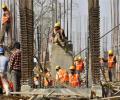
India's economy has bounced back amazingly from the Covid-19 pandemic and nationwide lockdown over the last one year, but it is not out of the woods yet, according to the World Bank, which in its latest report has predicted that the country's real GDP growth for fiscal year 21/22 could range from 7.5 to 12.5 per cent.

Hike in excise duty on cement products is negative, but can be overwhelmed by improved demand from greater thrust on infrastructure and rural sector.

The survey noted that advertising campaigns supported the increase in new work growth in the sector amid competitive pressures.

The Cabinet, chaired by Prime Minister Narendra Modi, allowed contractors to move to the new, speedier arbitration process, approved the release of 75 per cent of the amount in dispute against bank guarantees and provided for a conciliation board comprising independent domain experts in new contracts.

With sentiment for the automotive (auto) sector turning positive, stocks of two-wheeler auto majors have been hitting their 52-week highs. Hero MotoCorp, Bajaj Auto, TVS Motor Company, and Eicher Motors recently reached their yearly highs on strong sales in the festival season and the expectation of faster growth rates ahead. Since the start of this month, listed two-wheeler majors have delivered returns in the 12-17 per cent range, compared to the 7 per cent gains for the S&P BSE Auto Index and 3 per cent for the benchmark S&P BSE Sensex.

The headline for corporate profit growth has been very encouraging in the July-September quarter (Q2) of 2023-24 (FY24), with the combined net profit of listed companies up by 38 per cent year-on-year. However, the earnings distribution has been very lopsided, with most of the growth coming from public-sector oil-marketing companies (OMCs), banks, non-bank lenders, automobile (auto) companies, and cement producers. By comparison, companies from information technology services, fast-moving consumer goods (FMCG), retail, and consumer durables were disappointed, experiencing a sharp slowdown in net sales growth and a relatively muted increase in reported net profit.

Steel, cement, aluminum, fertilisers, tractors, two-wheelers, beverages and carbonated drinks, tyres and FMCG could see demand back to near normal levels by the third or the fourth quarter of the financial year, or even earlier.
India received a record foreign direct investment of $3.75 billion (Rs 17,266.52 crore) during the calender year 2004, government said on Wednesday.

A reading below 50 means contraction in the sector.

A rise in farm sector is estimated to raise demand for industrial goods and services, it added.

About 60 per cent of net sown area of the country is rain-fed. With every one per cent deficit in rains, the country's gross domestic produce falls by 0.35 per cent.
First investment by the group in aviation; deal size may be less than Rs 100 crore.

If a 5% to 10% fall in the equity market gives you sleepless nights, you are not cut out for a 75% to 80% allocation to equities and must reduce it.

On an average, PMEAC said economic growth could be around 6.5 per cent.

Economic Survey says Services Sector Negotiations at WTO Crucial.

Union Budget 2012-13 has given some relief for coffee sector as the Finance minister proposed to reduce basic customs from 7.5 per cent to 5 per cent on specified coffee plantation and processing machinery.

The country's GDP grew at the fastest pace in seven quarters at 7.7 per cent in the January-March period, retaining the fastest growing major economy tag on robust performance by manufacturing and service sectors as well as good farm output.

The minimum lending rate, or base rate, is what a bank can charge from a customer. The new regime, which will come into play from July 1, is intended to bring about more transparency in the lending operations of banks.

Among the main gainers were Jio Financial Services which jumped 4.99 per cent, Tata Steel (2.09 per cent), Maruti Suzuki (1.87 per cent), M&M (1.31 per cent) and Infosys (1.19 per cent).

Equity benchmark indices Sensex and Nifty on Friday reversed their six-session losing streak and rebounded more than 1 per cent on value buying in auto, IT, financial and energy stocks. Better than expected quarterly financial results of corporates also boosted investor sentiments even as uncertainties persisted over the escalating tensions in the Middle East, according to analysts. In a largely range-bound trade, the 30-share BSE Sensex rose 634.65 points or 1.01 per cent to settle at 63,782.80 points.

At the moment, the base rate of the bank stands at 10 per cent.

Finance Minister Arun Jaitley said that at a time when the private sector has been somewhat conservative in investments, public investment always takes the lead.

Analysts remain selective on cement stocks amid the likely government's capex push ahead of the scheduled general elections in May 2024. While UBS has initiated coverage on the Indian cement sector with an anti-consensus negative view and suggests investors sell select cement stocks on a rally, those at Nomura remain selectively bullish on the sector and prefer companies with large brownfield optionality and multi-region presence. In the near-term, UBS expects strong earnings of cement companies in the next two quarters to be driven by robust demand and margin tailwinds, but suggests any sharp uptick in stock prices could offer a good opportunity for booking profits in the related counters.
